Friday, October 28, 2011

About Yunny Power

Hello! My name’s Yunny Power. I’m currently a Junior at Oakland High School. The schools I attended were Bella Vista Elementary and Edna Brewer Middle School. I have attended many community services, and tutored my neighbor's kids. I'm not getting paid, but the feeling of being able to help those in need feels wonderful. I'm in Oakland High's KIWIN'S, and been a member of AYPAL for two years. When I get into college, I want to major in the Marketing or Psychology field. My hobbies are the typical things everyone else loves to do- spending time with their friends and family.

Monday, October 24, 2011

Ch 1 Real World Function


Definitions:
Relation is a set of ordered pairs.
Function is a relation for wich each element of the domain corresponds to exactly one element of the range.
The graph on the right shows the 6 flower species as the independent variables and their native habitats as the dependent variables. The domains are the flowers: plum blossom, lotus, musk rose, ixora, prim rose, foxglove; the ranges of the function are the countries: China, India, Malaysia, England. Since each of these flowers had 1 original nativity this is a function.
In the graph on the right I added the bombax ceiba flower specie, which was distributed in 3 places. The domains are now including plum blossom, lotus, musk rose, ixora, prim rose, foxglove, and bombax ceiba; the new ranges are China, India, Malaysia, England, and Australia. Since 1 of the domain had match with more than 1 range, the function failed and the graph is a relation.

Tuesday, October 18, 2011

1 How to Do Real World Functions


1. Choose a real world function
2. Describe and draw a picture for your function.
3. Describe and draw a picture when your function fails (i.e. when it is a relation not a function)
4. Include the definition of function and relation in your descriptions for 2 and 3
5. Identify the following:


Independent Variable
Dependent Variable
Domain
Range

6. Draw a graph of your function on the Cartesian Coordinate Plane

Note: see An Example Student for an example of how to do this project.

Monday, October 10, 2011


Ch0 Graphing Functions by Tam Equation


For the Ch.0 Graphing Functions. I'll show the 


different transformation of a function.


_The original Function is y = x^3 


_The Vertical Translation, the function is 


y = x^3 +2. I moved it up 2 units.


_The Horizontal Translation, the function is 


y = (x+2)^3. I moved it 2 units to the left.


_The Reflection, the function is -x^3. I just flipped


the original across the y-axis. 

_The Vertical + Horizontal, the function is 


y = (x+2)^3 -3. I moved it 3 units to the left and 


down 3 units. 

_The Translation + Reflection, the function is
y = -(x+2)^3 +3. I moved it 2 units to the left and 


up 3 units.


Chapter O Graphing Functions by Clinton Medium


In Chapter 0 we learned about transforming parent functions. The original equation was y=|x|. The vertical translation of y=|x|+2 is moved up by 2. The horizontal translation of y=|x-2| is moved to the right by 2. The reflection of y=-|x| is reflected across the x axis. The combination of Vertical land Horizontal of y=|x+3|+1 is moved up by 1 and to the left by 3. The vertical stretch of y=|2x| is stretched by 2.

Thursday, September 29, 2011

Ch 0 Graphing Functions by Esther Infinity


In our Ch. 0 Graphing Functions Project, we illustrated the different transformation graphs of five different functions.
1. The original parent function is y = x2.
2. The vertical translation, with a function of y = x2 - 3, is shown in blue. I moved the parent function down 3 units.
3. The horizontal translation, with a function of y= (x - 3)
2 , is shown in red. I moved the parent function 3 units to the right.
4. The vertical + horizontal translation, with a function of y = (x - 3)
2 - 3, is shown in purple. I moved the parent function 3 units to the right and 3 units down.
5. The horizontal reflection, with a function of y = (-x)
2 , is shown in pink. I flipped the parent function graph across the x-axis.
6. The vertical reflection, with a function of y = -x2 , is shown in green. I flipped the parent function graph across the y-axis. Also, since the parent function and the horizontal reflection would equal the same, they have the same graph.
7. The vertical + horizontal translation + vertical reflection, which a function of y = | x - 3 | - 3, is shown in orange. I flipped the vertical + horizontal translation function (purple) across the y-axis.

Wednesday, September 28, 2011

Ch. P Graphing Functions

This project shows graphs of different functions, with the functions we did different transformations.  
1.First I graphed the parent functions which was at the origin. y=x2
2. Then we graphed the vertical translation, which moved the parent function on the Y axis. y=x2+3 
3. horizontal translation is when the parent function is moved on the X axis. y=(x-3) 
4. Both the vertical and horizontal translation are used.
5.  The Horizontal reflection reflects the Y axis. y=(-x)2   
6. Vertical reflection reflects the X axis. y=x2 
7. Vertical and horizontal translation and vertical reflection, this is graphed by applying the rules explain above. y=-(x-3)2+3   

About Jason Midpoint

I began school in Sebrante Park elementary but moved to several elementary schools which were garfield and franklin elementary. I also attended Roosevelt for my middle school years. I worked for Team Oakland during the summer and also volunteer at the Oakland Public library. When i grow up I want do create graphic art for videogames or maybe become a lawyer. My favorite thing to do is run and play basketball as well as playing videogames on my free time.

Ch. P Graphing Functions by Jason Helix


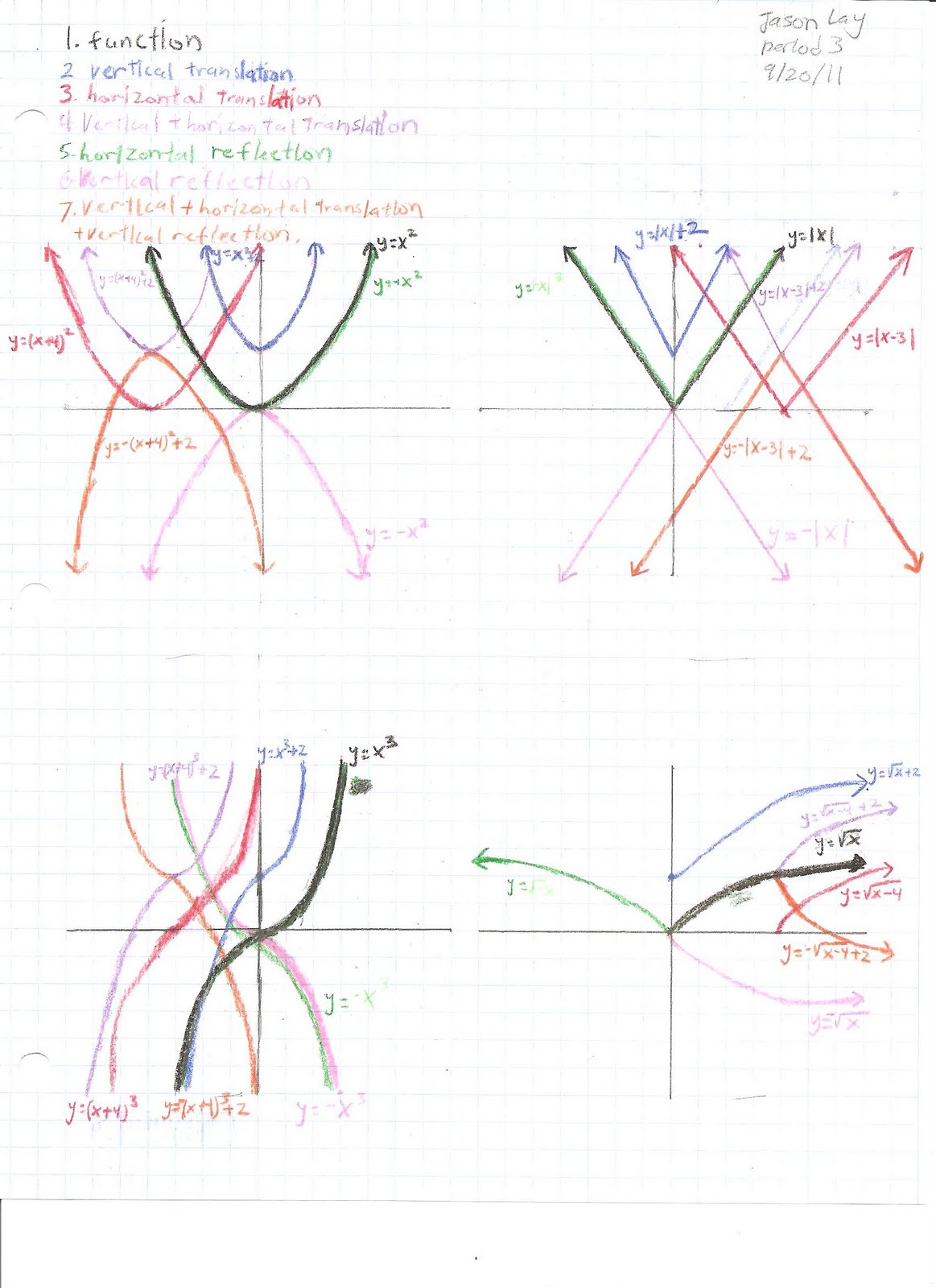
In our CH 0 project, we graphed parent functions. with the functions, we used the function to create a variety of transformations. The graph in top right corner shows the function in black, y=|x|. The blue is the vertical translation of the parent function, which is y=|x|+2. The red is the horizontal translation changing to y=|x-3|. The purple is both a vertical and horizontal translation making it y=|x-3|+2. The green one is a horizontal reflection, which goes across the y-axis, equaling to y=|-x|. The pink is a vertical reflection across the x-axis, forming y=-|x|. The orange one is a vertical and horizontal translation, with a vertical reflection, creating y=-|x-3|+2.

Ch. P Graphing Functions by Donald

In this project we had to draw transformations and each transformation contains a function. For example y= x^2 is the function for a parabola and y= |x| is the function for the V. I've drawn changes to the function and the orange parabola directly to the bottom of the center parabola is a vertical translation and and the green parabola directly to the left of the center parabola is a horizontal translation. There are four parabolas going up and two going down. The two going down are reflections of the parabola and both of which are in the negative x-axis. The y-axis cuts the 3 parabolas in the middle in half!

Tuesday, September 27, 2011

Ch. P Graphing Functions by Lan Expression


Our project for chapter P is graphing parent functions. In this project, we had to make some transformations to the parent functions. The transformations were Horizontal & Vertical Translations, and also Reflections across the X-axis and Y-axis. The parent function that I graphed was the Quadratic Function y= x^2 (Top left corner graph).
First, I graphed the original function (y=x^2) in black.

Then, I did a Horizontal Translation 4 units to the right in red which has the equation (y=(x-4)^2).

Next I did a Vertical Translation 5 units up in blue which has the equation (y=x^2 +5).

After that, I did a combination of both a Horizontal and Vertical Translation which makes the original graph shifts right by 4 units and up by 5 which is represented by the equation (y=(x-4)^2 + 5) in purple.

Now we go on with the reflections.

First, i did a Reflection across the Y-axis, it basically just flipped the original graph around across the Y-axis in green(on top of original graph in black) which look exactly like the original graph and gives us the equation (y=(-x)^2).

Then I did a Reflection across the X-axis which flips the original graph across the X-axis like the one in pink which is represented by the equation (y=-x^2). Last but not least.

I combined all the transformation made in this graph.

I did a Vertical and Horizontal Translation of 5 units up and 4 units right followed by a Reflection across the X-axis in orange which gives me the equation (y=-(x-4)^2 -5).

CH P Graphing Functions by Daniel


The function of this graph is Y=X^2 and our goal is to move it to different spot through translation and reflections which causes transformation in the graph.

1) The Vertical Translation is to move the Y=X^2 function vertically by adding a number. My graph shows Y=X^2+4

2) The Horizontal Translation is to move the Y=X^2 function horizontally by placing X in parentheses together with a number. My graph shows Y=(X-3)^2

3) The Vertical and Horizontal Translation is to move the Y=X^2 function both horizontally and vertically by putting step 1 and step 2 together which gives you Y=(X-3)^2+4

4) The Horizontal Reflection is formed when the function gets flipped around through the y-axis and gives us Y=(-X)^2

5) The Vertical Reflection is formed when the function gets flipped around through the x-axis and gives us Y=-X^2-2

6) The Vertical and Horizontal Translation plus Vertical Reflection is when Step 1,2 and 5 is added together and that gives us Y=-(X-6)^2-2

Ch P Graphing Functions


For our project, we had to graph the five parent functions, and this is one of them. Y= cube root of x. ( The last picture of the five)
1) This is the original function y= the cube root of x before any transformation, in the lime green color.
2) I then performed a vertical translation of 4 units up by adding it after the function, in purple color. See above.
3) Following after the vertical translation was a horizontal translation of 2 units left, shown above in the pink color.
4) The sky blue function shows the original function translated both vertically and horizontally.
5) The black function above is a vertical reflection of the original function.
6) The orange function is a horizontal reflection of the original function.


CH 0 Graphing Functions by Berenice Base


Our project was about the different types of parent functions.On these parent functions we had to preform transformations. The type of transformations that we had to do were vertical and horizontal translations.Also reflections over the x-axis and y- axis. One of these parent function that I graphed was the quadratic graph. It is on the far left. the original parent function was y=x squared.after graphing the original graph i did a vertical translation two units up. then i did a horizontal translation two units to the right.Then i combined the two to create a vertical and horizontal translation y= (x-2) squared + 2. After this i did a horizontal reflection y=-x squared. then a vertical reflection y=x squared. finally i graphed a vertical + horizontal translation + vertical reflection.


Ch. P Graphing Functions


Our chapter P project was to graph parent Functions. We had to we did our project on graphing parent do many different types of Transformations. My parent function was y = |x| which looks like a V shape. What I did first was to graph the parent function y =|x| which is in the middle covered by the brown line and the brown color is a Reflection across the Y-Axis or a horizontal reflection y=|-x|. Since reflecting across the Y-Axis for this function, it'll look exactly the same since it is symmetrical on both sides. My next translation was a Vertical Translation y=|x| + 3 where I move the function up by 3 indicated by the orange line. This shows that the function moved up by 3. Then I used the Horizontal translation y=|x-1| indicated by the red lines which shows the graph moved to the right by one. After that, I combined the vertical and horizontally translation together y=|x-1|+3 to move it up 3 and right one shown by the green line. After doing that, I made a reflection across the X-Axis y=-|x| which flips the equation upside down shown in blue. The last transformation what a vertical, horizontal translation, as well as a vertical reflection y=-|x-1|+3 where I move to the right one, up 3, and flip it outside down